I Can Totally Make That: Graphics & T-Shirt Designs
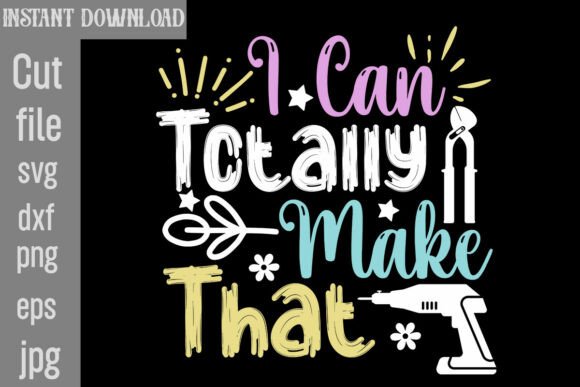
As a handmade business designer who’s shipped over 12,000 custom items—from Cricut-cut tote bags to sublimated mugs and Etsy-printable planner kits—I opened I Can Totally Make That SVG Cut File with quiet curiosity. Not hype. Not hope. Just the steady, slightly skeptical eye of someone who’s lost hours to messy vectors, misaligned layers, and PNGs that ghost on dark fabric. What I found? A refreshingly confident, clean, and versatile graphic design asset—playful but not childish, bold but not overwhelming—that immediately clicked into my current spring collection workflow.
The first impression is pure craft energy: cheerful, hand-drawn charm meets crisp vector precision. It leans into joyful minimalism—rounded lettering, friendly spacing, subtle texture in the stroke weight—without sacrificing cutability. This isn’t “cute for kids only.” It’s the kind of T-Shirt Designs that resonates with makers, teachers, plant moms, and small biz owners who wear their passion literally on their sleeves. It feels like encouragement you’d pin to your studio wall—or stitch onto a denim jacket.
In real crafting life, I Can Totally Make That SVG Cut File landed across five projects in one week: a batch of vinyl-mug wraps for a local coffee shop collab, a set of matte sticker sheets for planner lovers (using the PNG at 300 DPI), iron-on transfers for cotton tees sold via Etsy, tumbler wraps for a bridal shower order, and printable gift tags bundled with handmade soap. Each time, it performed without fuss—no stray anchor points, no overlapping paths, no hidden layers that break Silhouette Studio’s auto-trace. The SVG file imported cleanly into Design Space; the DXF held its shape in Silhouette; the EPS scaled flawlessly for sublimation mockups; and the PNG delivered crisp edges every time—even when resized down to 1.5” for mini sticker sheets.
This graphic design asset shines brightest where intention meets execution: large-format cut files for tote bags or canvas wall art, clean printable layouts for greeting cards or digital planners, seasonal craft bundles (think “I Can Totally Make That” + “Spring Plant Mom” + “First Time Sewist” as a trio), and gift products where tone matters as much as typography. It’s also ideal for small business branding—slipped subtly into packaging labels, thank-you cards, or Instagram story highlights. When paired with a warm serif font for product descriptions or a clean sans for tags, it elevates handmade credibility without shouting.
That said—every seasoned crafter knows: not all graphics play nice in every medium. Use I Can Totally Make That SVG Cut File carefully for very small sticker cuts under 1”, especially if using thin vinyl or intricate weeding tools. While the lines are generous overall, the inner counter of the “O” and the curve of the “G” shrink fast below 1.25”. Also, avoid stacking multiple colors in layered vinyl projects unless you’re aligning manually—the design wasn’t built for multi-layer registration. And while the PNG has a transparent background and 300 DPI resolution (perfect for print-on-demand and sublimation), always preview it on both white and dark substrates before bulk printing. I caught a slight gray halo around the letters on black mugs during my first test—easily fixed by re-saving the PNG with “matte off” in Photoshop, but worth checking.
Here’s what I do before any I Can Totally Make That SVG Cut File goes live in my shop: First, I open the SVG in Inkscape just to confirm all strokes are outlined and there are zero compound paths. Second, I drag the PNG into a mockup template and zoom to 200%—checking for pixelation or anti-aliasing fuzz. Third, I resize it for three key products (a 12oz mug, a unisex tee, and a 3x4” sticker sheet) and run a quick color contrast check using WebAIM’s contrast checker—especially important since many buyers use these for accessible printable designs. Fourth, I pair it with three fonts in Canva: a relaxed script for social posts, a sturdy sans for product tags, and a vintage serif for printed packaging—and note which combo feels most authentic to my brand voice.
And yes—I double-checked the commercial license. Every time. Because I Can Totally Make That SVG Cut File is marketed as a DIGITAL DOWNLOAD ONLY with files clearly labeled for Cricut, Silhouette, vector editing, and high-res printing, but licensing details make or break handmade business risk. Mine allows unlimited physical product use, no attribution required, and covers Etsy, craft fairs, and local markets—but prohibits resale of the raw files. That fits my model perfectly: this stays a graphic design asset, not a standalone digital product.
Where does it fit in the broader creative marketplace? Think beyond single-use. Bundle it with coordinating clipart—like tiny scissors, spools of thread, or watercolor brushes—to build a full “Maker Mindset” design bundle. Use the EPS version to create embroidery digitizing guides. Drop the PNG into a printable wall art PDF with matching quote cards and affirmation stickers. Or feature it as the hero graphic in a “Beginner’s Cricut Project Kit” digital product—complete with step-by-step video links and material lists.
For Etsy sellers juggling seasonal demand, this is low-friction inventory: no shipping, no inventory tracking, just smart reuse across formats. For craft fair vendors, it’s a fast way to offer personalized items on-site—cut, press, and hand over in minutes. And for hobby makers leveling up into creative entrepreneurship? It’s proof that great Graphics don’t have to cost hundreds—they just need to be well-built, thoughtfully licensed, and ready for real-world making.
Bottom line: I Can Totally Make That SVG Cut File isn’t magic. It’s reliability dressed in joy. It’s the kind of T-Shirt Designs that starts conversations, fits seamlessly into your existing product mockups, and holds up under the scrutiny of actual crafting—not just Pinterest boards. If you’re building a handmade business where authenticity, clarity, and craft-first functionality matter, this graphic design asset earns its place in your working library—not as decoration, but as dependable infrastructure.